

If you are looking for How to Start an E-commerce Business in India (Step-by-Step Guide), then this guide will assist you to understand all the stages of setting up a profitable online business. Whether you are willing to start an Amazon business, Flipkart business, Meesho business, or Shopify website, this guide will help you.
Setting up an Online Business has become very simple yet highly competitive. Each and every day, countless numbers of entrepreneurs, students, and professionals are dreaming about starting a profitable E-commerce Business. But many beginners are unable to do it simply because they are unaware of how to get started, what platform to use, and what is online marketplace.
E-commerce Industry in India is growing at a rapid pace with millions of buyers buying products each day online. There are great opportunities available for students, working professionals, homemakers, manufacturers, wholesalers, and even small businesses.
Let’s learn how to set up your online business.
Why Ecommerce is Growing Rapidly in India
Several reasons have contributed to the growth of India’s ecommerce market, which is now among the world’s fastest-growing ecommerce markets:
- Increased use of smartphones
- Affordable internet availability
- Adoption of digital payments
- Improved logistics and delivery services
- Increased customer confidence in online shopping
- Government support to digital enterprises
As per industry research reports, India’s ecommerce market is likely to grow at a much faster pace in the next few years, hence becoming an ideal time to venture into this industry.
Advantages of Starting an Ecommerce Business
- Low-cost business than brick-and-mortar retail store
- Sell your products to all over India
- Work from anywhere
- Flexible business nature
- Multipronged revenue sources
- Scalable business
If you are a student interested in pursuing an Ecommerce career or an entrepreneur thinking of setting up a big enterprise, ecommerce can offer opportunities for both types.
Ready to Build Your Ecommerce Business?
Don’t leave your success to trial and error.
Learn from industry experts at Alram Academy, Jaipur, and gain practical skills in Amazon, Flipkart, Meesho, Shopify, Amazon FBA, Product Listing, Marketplace Management, and Online Selling.
👉 Book Free Demo
Step 1: Choose the Right Ecommerce Business Model
The first and most important thing while setting up an e-commerce business is to decide the right business model. It means that one should determine whether to go with marketplaces like Amazon, Flipkart, Meesho, and other e-commerce platforms or to build their own online store. The right choice of business model will give the foundation of success.
Amazon Seller
Being an Amazon Seller enables you to get access to customers across the nation. Amazon also provides Amazon FBA services, which enable Amazon to store, pack, ship, and handle customer service for your products.
Flipkart Seller
As a Flipkart Seller, you will be able to get access to Indian customers using one of the biggest ecommerce marketplaces in India.
Meesho Seller
A Meesho Seller gives you access to cost-conscious customers and resellers with very little start-up cost.
Build Your Own Website
In addition to using marketplaces, some companies create their own ecommerce website through Shopify or WooCommerce.
Advantages are:
- Full control over branding
- Strong customer relationships
- Higher profits
- Development of an independent business
The Shopify Course will assist novices in learning how to build their website, process payments, and manage their store.
Step 2: Choose a Profitable Product
The sale of a profitable product serves as the basis for any ecommerce enterprise that succeeds. One should consider products that enjoy steady demand, profitability, and moderate competition. Prior to picking the product, one should conduct some research into market trends and what competitors offer. The choice of a proper product enhances the odds of success.
How to Find Winning Products
Think about products which:
- Address daily challenges
- Enjoy steady demand
- Have reasonable competition
- Carry favorable profit margins
- Are portable for easy shipping
Example
As an alternative to common phone covers which have many competitors, go for designer covers designed specifically for some smartphone models.
Niche products outperform highly competitive products.
Step 3: Register Your Business and Complete Legal Requirements
Legally, you will build trust from customers and lay down foundations of future growth for your venture.
Basic Formalities
PAN Card, Aadhar Card, Bank Account, Mobile Number, Email ID
Business Registration (Optional initially)
Based on the size of your business
Sole Proprietorship, Partnership, LLP, Private Limited Company, GST Registration
GST registration might be necessary based on the business model and the selling platform. Many marketplaces ask for GST in several categories of products.
Step 4: Create Seller Accounts on Marketplaces
After getting your documents ready, open seller accounts.
Amazon Seller Registration
You may usually require:
- PAN
- GST (if applicable)
- Bank account
- Proof of address
- Mobile number
Learn Amazon Seller Central
Understanding Amazon Seller Central is important because you will be handling:
- Orders
- Inventory
- Pricing
- Listing of products
- Advertising
- Customer messages
Flipkart Seller Registration
The Flipkart Seller Dashboard will enable you to handle:
- Inventory
- Product uploads
- Promotions
- Shipping
- Payment process
Meesho Seller Registration
Meesho Supplier Panel will allow sellers to:
- Upload products
- Price products
- Manage orders
- Delivery Tracking
Step 5: Create High-Converting Product Listings
A well-optimized Product Listing plays a crucial role in attracting customers and increasing sales. Use keyword-rich titles, high-quality images, compelling descriptions, and clear bullet points to showcase your product’s benefits. An informative and professional listing improves search visibility, builds customer trust, and boosts conversion rates on ecommerce marketplaces.
Your Listing Should Include
- SEO-Friendly Product Title
- High-Quality Images
- Detailed Product Description
- Bullet Points
Step 6: Learn Marketplace Management
Online selling involves a lot more than just listing products.
For effective sales, one must understand Marketplace Management.
Important aspects include:
- Stock Management
- Order Management
- Customer Service
- Pricing Strategy
- Return Management
- Review Management
- Sales Performance
Good management translates into positive seller ratings and repeated orders.
Step 7: Use Amazon PPC and Digital Marketing
Even the best products require exposure.
Amazon PPC
Amazon PPC makes products visible through sponsored searches.
Some of the advantages are:
- Increased exposure
- Quicker sales
- Improved keyword ranking
- Higher conversion rates
Discover:
- Keyword Research
- Campaigns
- Bid Optimization
- Negative Keywords
- ACoS Analysis
Further Marketing Platforms
- Boost your business through:
- Instagram Marketing
- Facebook Ads
- Google Ads
- WhatsApp for Business
- Email Marketing
- Influencer Marketing
A successful business needs to have marketplace sales coupled with marketing through other channels.
Step 8: Scale Your Ecommerce Business
After having made sure that your e-commerce business is getting consistent sales, the next step is to start scaling. This involves increasing the range of products being offered, selling through multiple e-commerce platforms such as Amazon, Flipkart, and Meesho, marketing your products, and even building your own brand.
Learn Ecommerce at Alram Academy, Jaipur
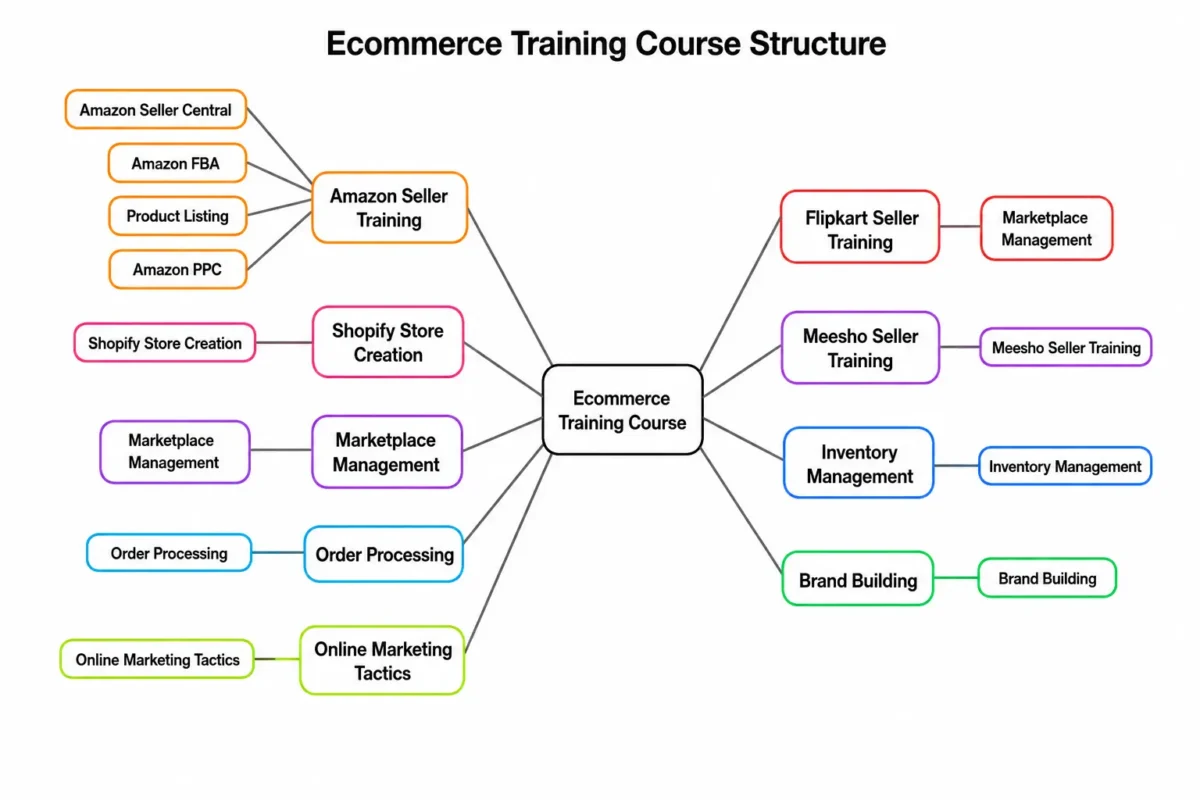
Those who wish to be successful in establishing an ecommerce business, there is Alram Academy, which is located in Jaipur and is an Ecommerce Learning Institute providing ecommerce training to students, entrepreneurs, job seekers, and business persons.
The courses offered at the institute include:
- Amazon Seller
- Flipkart Seller
- Meesho Seller
- Shopify Course
- Amazon FBA
- Product Listing
- Amazon PPC
- Marketplace Management
- Online Selling
- Ecommerce Business Strategies
By working on various projects and getting training from expert tutors, the students will be able to establish and run their ecommerce business. They can also opt for Ecommerce Jobs and make an Ecommerce Career for themselves.
Why Ecommerce Training Matters
Most beginners only depend on YouTube tutorials or learning by doing. Although free tutorials help in the learning process, Ecommerce Training offers the right combination of theoretical knowledge, hands-on experience, mentorship, and guidance.
Effective training prevents avoidable errors and enhances the growth of the business.
Frequently Asked Questions
1. How much capital is needed to initiate an ecommerce business in India?
There can be quite a low capital requirement based on the choice of products, inventory and budget for marketing. Ecommerce through marketplaces typically needs less initial investment than setting up a physical shop.
2. What is the most suitable marketplace for novices?
Both Amazon, Flipkart and Meesho provide excellent prospects. It totally depends upon your choice of products, target customers and business objectives.
3. Is Amazon FBA beneficial?
Yes. Amazon FBA will help in managing the storage, packaging, shipping and customer service aspects which will leave you free for product sourcing and sales.
4. Can a student initiate an ecommerce business?
Yes, many students start with smaller inventories or through resale of products and scale up their business with experience.
5. Should one go for ecommerce training?
It is not a must but will definitely reduce the learning time to a large extent.
Final Thoughts
It is not true that an ecommerce business can only be started by huge organizations. Anyone can start their own ecommerce business successfully if they plan well, select products correctly, strategize on marketplaces, and keep learning.
If you follow this article on How to Start an Ecommerce Business in India then you will get to know how to select products, make professional listings, use Amazon FBA, optimize using Amazon PPC, run marketplaces, and create your brand.
To succeed in ecommerce, one needs to learn and take consistent actions based on data and customer satisfaction. Whether you want to become an Amazon Seller, Flipkart Seller, Meesho Seller, or a Shopify store, you need to start the process of ecommerce now.